Showing posts with label Jowai. Show all posts

Thursday, February 23, 2012

Jowai

P2110013.jpgAfter a week in Shillong with some friends, I arrived in Jowai. This is a busy town that serves as the gateway from the Jaintia Hills district to the rest of India. There's a lot of coal mined in the area and all the big multicolored Tata trucks ply their slow way along the windy one-lane roads through the town. I spent one night with my friend Henry in Nongbah village, which is where Kiang Nongbah, the famous freedom fighter of the Pnar, hails from. I stayed in Henry's wife's house, which is just up the hill from the house where Kiang Nongbah lived, which is now home to the village headman. Henry told me that all of Kiang's family was hunted by the British, so that to this day no one knows who his descendants are.

P2160054.jpg

The next morning I returned to Jowai where some other friends helped me find a room near the Presbyterian Mission Hospital. I've enjoyed staying there for the past week or so, though the room is rather bare. At a local woodworking shop I ordered a small dresser, and another friend may be able to build me a rack for hanging clothes. My time has been spent working on a phonology paper and building a dictionary for Jowai-Pnar and getting example sentences. I'm hoping to begin recording traditional stories in the next week or two.

Wednesday, June 29, 2011

Pnar Church Service

I went to church with a friend in Jowai on Sunday, the Presbyterian Church there - it was pretty cool. I definitely didn't bring the right clothes to India for going to church - all the men wore suits and ties if they had them, but I didn't mind that too much. Although when you stand up to sing hymns and you're a head taller than the tallest person in the room, it can be a bit uncomfortable. Fortunately I'm used to being stared at from growing up one of the only white people in an all-black country. I think my friend was a bit more nervous to be sitting next to me, since she lives there and knows how little excuse people need to gossip.

The service was all in Khasi, which is the dominant language spoken in this area. The hymns were in Khasi and there was no percussion to keep time so the singing slowed down to an almost inexorable pace. It was100_0621.JPG neat to be able to pick out some words here and there, and my friend translated some of the verses for me so I could understand what I was singing. The orthography is relatively systematic.

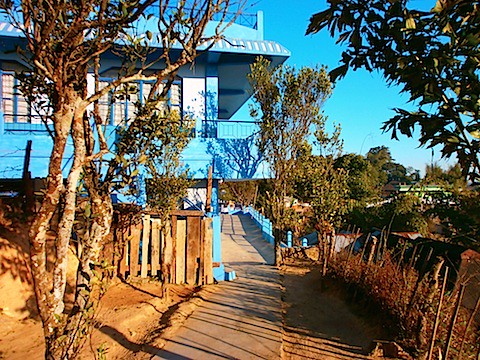
In the evening we went to their cousin's home, which is up on a hill above the river on the outskirts of town (where the picture on the right was taken). We stayed for a home church service led by some of the church elders, which is where the real meat of the Christian culture in Jowai seems to be. Pretty much the whole service, except for a few songs and prayers, were in Pnar, including the sermon. Traditional instruments - a mandolin and tambourine - as well as clapping and harmonies kept the songs upbeat and lively.
Thursday, June 09, 2011

India Week 3: Jowai

I recently got back to Shillong from Jowai, where I was gathering data on the main Pnar dialect. Jowai is the cultural and administrative centre of the Pnar community in Jiantia Hills, and I'll be focusing on learning to speak the variety of that place. I was able to connect with Ram, who is part of the Passah clan and very involved with the traditional religion. We were able to go down to the archery field where men shoot arrows at a target on a daily basis, and conduct some interviews about the origins of this event.

100_0556.JPGRam also showed me around the area - on Sunday we went to a waterfall further south of Jowai, toward Bangladesh, which was a lot of fun. The walk down was a bit slippery, but once down the water was cool and inviting. I swam up behind the waterfall and waved to Ram and his cousins on the other side. Here's me and the waterfall in all its glory.

Language data-gathering was also productive. Besides the interviews, I was able to collect a couple wordlists and a retelling of The Pear Story, following a technique used by my advisor Alec Coupe for collecting language in context to make grammatical structures easier to identify. I'll be working on translating these texts in the coming weeks and in analyzing the wordlists to acquaint myself with the phonology of Pnar.