Showing posts with label dance. Show all posts

Tuesday, May 15, 2012

Naming Ceremony

Last week I was invited by my friend Heibormi Sungoh to observe a traditional Jaintia naming ceremony in Shangpung, a town not too far from Jowai. This was the third and final part of the naming ceremony, and as things went along they explained bits and pieces to me.

The first thing that happened was the family arriving at the home where the event was taking place. The wife's family brought gifts of alcohol and food, and each person bringing items gave a greeting/invocation which the family responded to in kind. After some time, all the men of the family gathered outside the home, drank rice beer, and discussed the event. Once the event had been deliberated over, the gathering moved inside where all the women of the family were sitting and discussing. Then the invocation was given by the priest for 45 minutes or so.

The invocation is a sort of chant that apparently tells the story of the first birth and how the Pnar people got help from the plants and animals, in particular a certain kind of grass who helped them to deal with birth and began the naming process. During the chanting, the priest continued rubbing mustard seed oil on three blades of grass which he held between his fingers. Once the chanting had completed, he put one piece of grass above the door and cast the other two on the ground when recommended names were given. If the grass fell a certain way three times, the name was given to the child.
P5050004

P5050006Following this part of the ceremony, food was served, and the men once again convened after eating to continue their discussion of what had taken place. After some rice beer, the men reached some sort of agreement. The recordings I made still need to be analysed, but according to some of my friends they contain a lot of 'ktein kynnoh', which are idioms that are difficult to translate into English.

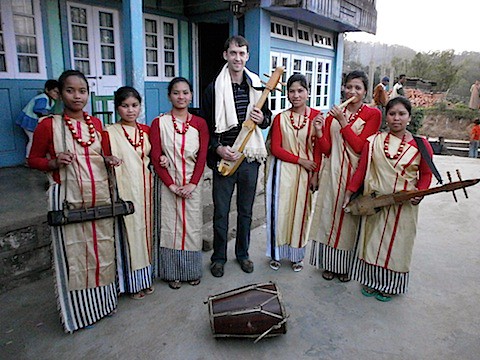
In the evening a local dance troupe came to present the traditional plate dance, and following the dance Heibormi and some other friends joined them with traditional music and song. I was able to film the whole thing, and here are a couple pictures of me with the group.

Monday, November 01, 2010

Cambodian Dance (among others)

A couple weeks ago I went with some friends to Singapore's Esplanade, a theatre and arts complex in center city, by the river. They were just finishing up a festival of dance (called 'Da:ns') and were particularly highlighting cultural dances from across Asia. We weren't able to go for all the dance events (click on the link above to visit the page that describes everything that was going on), but you can see we got to watch Japanese and Cambodian dancing. And true to Singaporean form, also got to participate in the western pastime of line-dancing.

The Japanese dance was very formal and structured, and we got to see three different dances - one with the fan that is the story of a beautiful maiden expressing her love for a visiting general with her precision and graceful movement. Then the men's dance which tells the story of men preparing themselves for war. The last one we saw is the story of a high-class woman who hardly ever has the chance to go out of the house - when at last she is allowed to go for a walk, she makes the most of it, playing and having fun.

The Cambodian dance was also quite formal but in a different way. The proper posture for these classically trained dancers is a curved back while they make precise, sculptural movements. It takes incredible control to keep those postures as they move slowly and carefully. They performed the story of Machhanup, which is unique to the Khmer version of the Ramayana and has been performed for over 1,000 years. I was reminded again how ancient some Asian cultures are.

Macchanup is the story of a great warrior who is the son of the monkey king and the mermaid queen. The monkeys built a stone bridge to the island of the giants so they could make war on them, but the mermaid queen didn't want the bridge across her land, so had her servants remove the stones. The monkeys were angry and jumped in to fight the servants, followed by their king who fell in love with the mermaid queen, resulting in Machhanup.

The rest of the story talks about how Machhanup grew up not knowing his father and became a great warrior, trained by a mighty giant. He ends up fighting his father until the mermaid queen tells them the truth of their relationship. The dance was performed by Apsara Arts Association, and I look forward to seeing more performances from them if I can make it to Cambodia or if they come back to Singapore.