Showing posts with label Jaintia Hills. Show all posts

Tuesday, May 15, 2012

Naming Ceremony

Last week I was invited by my friend Heibormi Sungoh to observe a traditional Jaintia naming ceremony in Shangpung, a town not too far from Jowai. This was the third and final part of the naming ceremony, and as things went along they explained bits and pieces to me.

The first thing that happened was the family arriving at the home where the event was taking place. The wife's family brought gifts of alcohol and food, and each person bringing items gave a greeting/invocation which the family responded to in kind. After some time, all the men of the family gathered outside the home, drank rice beer, and discussed the event. Once the event had been deliberated over, the gathering moved inside where all the women of the family were sitting and discussing. Then the invocation was given by the priest for 45 minutes or so.

The invocation is a sort of chant that apparently tells the story of the first birth and how the Pnar people got help from the plants and animals, in particular a certain kind of grass who helped them to deal with birth and began the naming process. During the chanting, the priest continued rubbing mustard seed oil on three blades of grass which he held between his fingers. Once the chanting had completed, he put one piece of grass above the door and cast the other two on the ground when recommended names were given. If the grass fell a certain way three times, the name was given to the child.
P5050004

P5050006Following this part of the ceremony, food was served, and the men once again convened after eating to continue their discussion of what had taken place. After some rice beer, the men reached some sort of agreement. The recordings I made still need to be analysed, but according to some of my friends they contain a lot of 'ktein kynnoh', which are idioms that are difficult to translate into English.

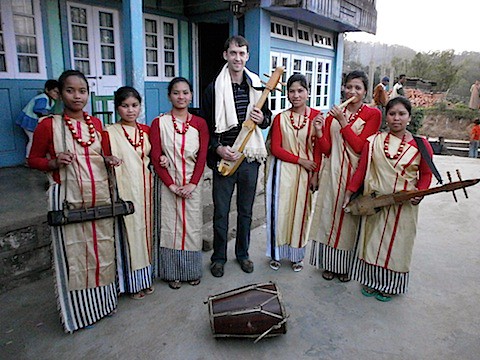
In the evening a local dance troupe came to present the traditional plate dance, and following the dance Heibormi and some other friends joined them with traditional music and song. I was able to film the whole thing, and here are a couple pictures of me with the group.

Sunday, April 15, 2012

Rongkhla Tiger Festival

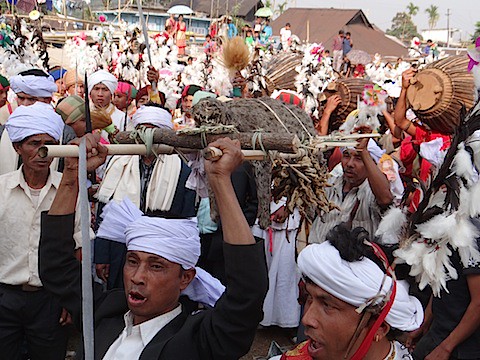
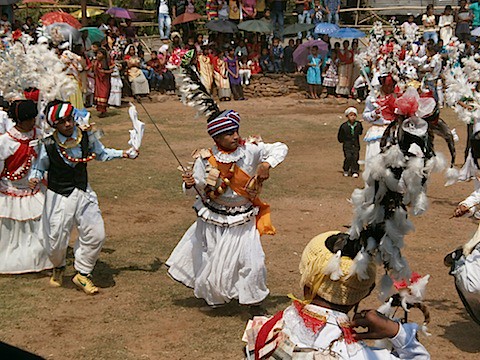
P3170028Last month some friends and I visited Nongtalang, a village south of Jowai where they speak the War language. My Pnar friends were going to document and record clips for the news channel, and I went along for the experience. A couple of my Australian friends came as well, since the event was a local festival that happens relatively rarely. This festival is called Rongkhla, and can only occur after a large cat has been killed ("khla" means 'tiger'). You can read more about the festival at my friend Rev. Mohrman's blog here.

DSC00263We really enjoyed the festivities - the dancers wore very colorful clothes and the music was lively. Most of the dancers wore traditional clothes, and people who liked their dancing would clip money to their shirts. It was quite an exciting experience. After the main event, the cat was carried down to the edge of town where the memorial stones stand, and at the end of the day the meat of the animal was thrown out to the onlookers. We were told that if you can eat a piece of the meat it brings good luck for the rest of the year.

For some video of the event (including where I got to drive on the Indian side of the road), check out this link or watch below: http://www.youtube.com/watch?v=5VVfpkjNkDE

Saturday, March 24, 2012

Ma Kamai

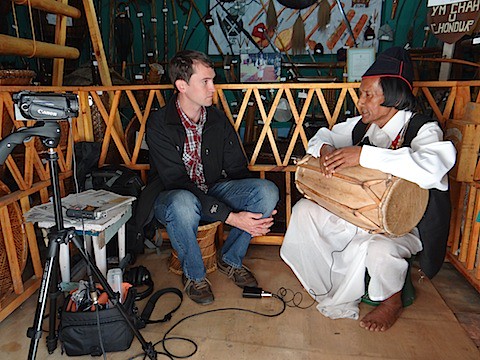
DSC00056Last week I had the opportunity to visit the Jaintia Arts and Culture Museum here in Jowai, which is the brainchild of Ma Kamai War, a local musician and caretaker of all things Pnar and an adherent of the traditional Ñiamtre belief system. He very kindly sat with me and recorded an interview in Pnar, explaining the history of the museum, how it started in 1993 and what its purpose is - to keep alive the knowledge of Pnar culture and arts. He then described each of the artifacts he has collected, from clothing to farming tools, dishes, baskets and instruments, carefully climbing over some things in order to get to others.

Amazingly, he has done this almost completely without external funding, though he could certainly benefit from funding that would help him expand the room he keeps everything in and turn it into a true display that people could wander through. To learn more about Jaintia artifacts, you can view his webpage here, and I'm hoping to edit the video soon, for a more interactive description.

Wednesday, March 14, 2012

Nartiang Monoliths

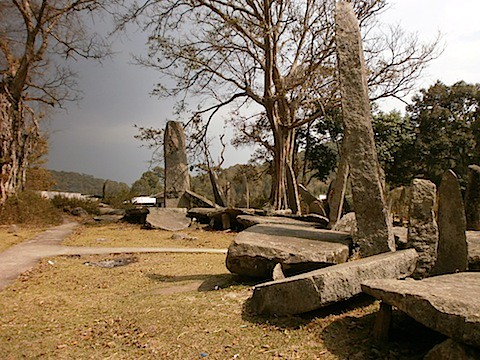
P3040001Last week my friend Ruhi took me along with some other friends to Nartiang, which was once the summer capital of the Jaintia kings, who ruled most of this area from the 1500's until they were deposed by the British East India Trading Company in the late 1800s. When the power shifted, trade shifted as well, so that the once-prosperous town of Nartiang is a quiet backwater.

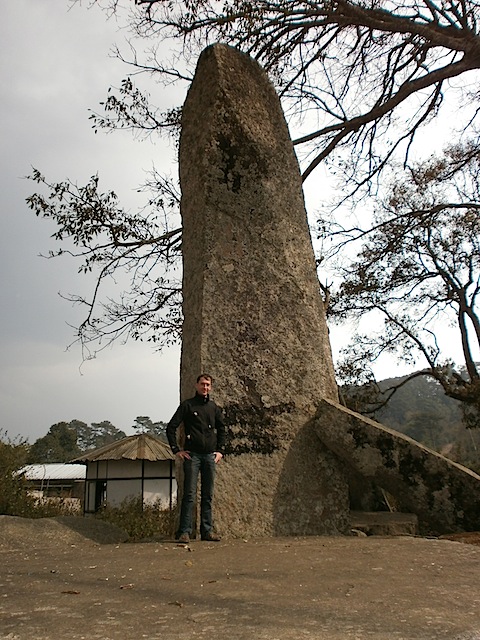
P3040011However, it still boasts the finest collection of monoliths in the area, on a special site where the king's soldiers gathered and erected large stones and set huge flat slabs on smaller rocks to create stalls where people could display their goods and elders could gather for meetings. It was quite an incredible experience. From pictures I had seen the stones looked rather small, but once there for myself I could see that it was more like a giant's playground. Just to give you an idea of the scale, here I am standing on a huge rock slab next to one of the stones. If you come to northeast India, this is one sight you won't want to miss.

Below is some video from our visit: http://youtu.be/YDk-IwlIwfU

Monday, March 05, 2012

Krangsuri Falls

P2280005

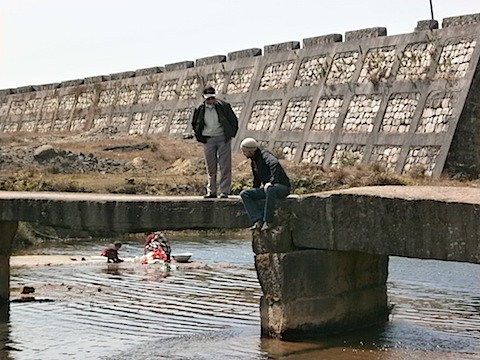
Earlier this week my friend Peter was in town looking for speakers of a different language. To aid in his search I introduced him to Ma Jowai, an older Pnar gentleman who knows a lot of people and has been helping me learn Pnar. Ma Jowai invited us to go with him to another waterfall, Krangsuri. So on wednesday we hit the road. Along the way we stopped to take pictures at an ancient bridge made by the Jaintia kings in the 1600-1700s. Just to give you an idea of the scale of the blocks they used, here's a picture of me and Ma Jowai on the bridge.

P2280030

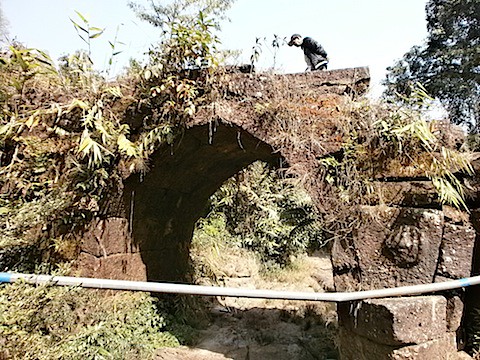
We continued on to the falls - it was a beautiful day for visiting the falls, with warm sun and slight breeze. Peter and I marveled at the stonework for the path on the way down, and another bridge along the way with a really cool arch. We walked around on the top of the falls, where the water escaped through the holes in the sandstone. I scoped out a spot to jump from when there's more water. The drop is only about 30 feet, and the water was so clear you could see where the boulders were.

P2280055

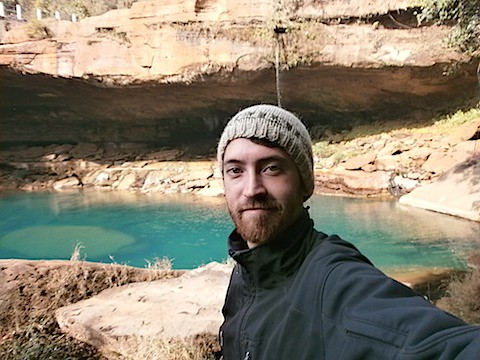
Down at the bottom the overhang was pretty extreme, thus the word "krang" in Pnar, which describes this kind of cave. I'm told that the word "suri" is a form of "churi", which is the old word for sword, as this is the place where the Jaintia king's soldiers would sharpen their swords. I'm looking forward to coming back in the summer, when the water is more extreme.